
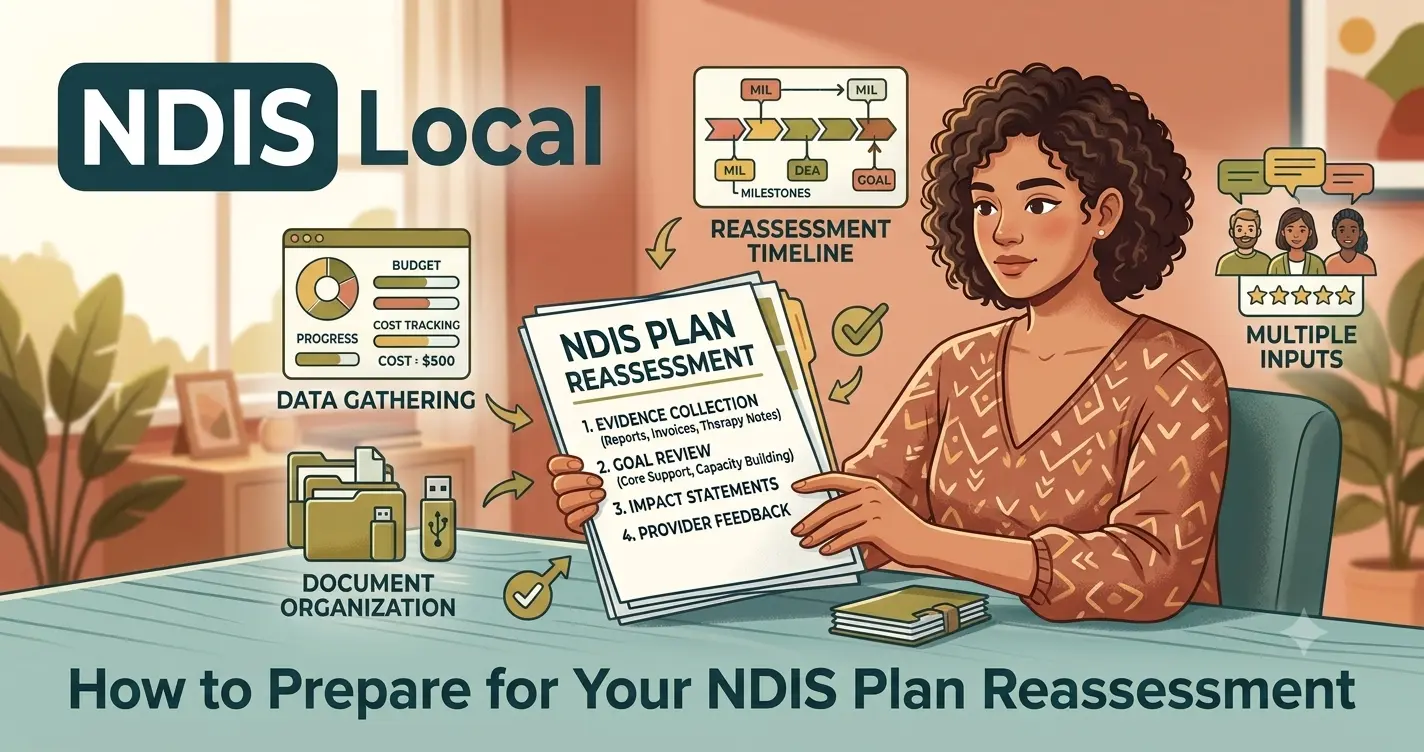
How to Prepare for Your NDIS Plan Reassessment
Throughout my time in this sector, if there’s one meeting I’ve seen more participants go into underprepared than any other, it’s the plan reassessment. I understand why — it can feel like a single conversation decides your funding for the next 12 months, which is genuinely stressful. The good news is that preparation makes a bigger difference here than almost anywhere else in the NDIS process. This guide is exactly what I walk my own clients through beforehand.
First, know which conversation you’re actually having
The NDIA uses two different terms, and mixing them up can cost you time. A plan variation is a small, targeted change to your existing plan — used when one specific thing needs adjusting before your plan naturally ends. A plan reassessment is bigger: the NDIA replaces your entire plan with a new one, based on a full look at your current needs, goals, and circumstances. If your current plan’s end date is approaching, you’re almost certainly heading toward a reassessment, not a variation.
Timing-wise, your NDIA contact will usually reach out around 2 to 3 months before your plan’s reassessment date for an initial check-in. Once the NDIA has everything they need from you, both variations and reassessments are meant to be completed within 28 days — but that clock only starts once your evidence is actually in, which is exactly why waiting until the check-in call to start gathering documents puts you behind from day one.
Start three months out, not three weeks out
This is the single biggest difference I see between reassessments that go smoothly and ones that don’t. The families who start preparing as soon as they get that initial contact — rather than scrambling once the meeting is booked — walk in with evidence that actually supports what they’re asking for. Here’s the timeline I recommend:
- As soon as you’re contacted (roughly 3 months out): book appointments with your key allied health providers — OT, physio, speech therapist, psychologist, whoever’s relevant to your supports — so their reports land in time rather than being requested in a rush.
- 6-8 weeks out: sit down with your support coordinator (if you have one) and go through your current plan line by line. What worked? What didn’t get used? What consistently ran short?
- 2-4 weeks out: finalise your evidence, confirm your goals in writing, and if anything about the upcoming community participation budget changes affects your plan, raise it directly with your coordinator so it’s addressed in the meeting rather than after.
What evidence actually moves the needle
Generic statements like “still needs support” rarely change an outcome. What does work is specific, current evidence that connects your supports to real functional impact. In practice, that means:
- Recent allied health reports — ideally within the last 3-6 months, specifically addressing how your current supports affect your daily functioning, not just your diagnosis
- A record of what changed since your last plan — health, living situation, family circumstances, employment, anything that shifts what you actually need day to day
- Usage patterns from your current plan — categories that consistently ran short (a strong case for more funding there) and categories barely touched (be ready to explain why, since unused funding invites questions)
- Clear, specific goals written in your own words, then translated into language that maps to NDIS support categories — this is somewhere a support coordinator earns their keep, since “NDIS language” isn’t always intuitive
A note on timing this year specifically
If your reassessment falls anywhere near October 2026, it’s worth raising directly with your coordinator ahead of time — that’s when adjustments to social, civic, and community participation budgets begin rolling out progressively. If a meaningful part of your current plan sits in that category, understanding how the timing lines up with your own reassessment date is worth a specific conversation, not something to find out mid-meeting.
What to do if the new plan doesn’t reflect what was discussed
This happens more often than people expect, and it’s not something to just accept quietly. If your new plan comes back and doesn’t match what was actually agreed in the meeting, or doesn’t reflect the evidence you provided, you have the right to request an internal review of the decision. If that doesn’t resolve it, external review is available through the Administrative Review Tribunal. I’d always try the internal review path first and lean on your support coordinator to help identify exactly where the plan diverged from the conversation — specificity matters far more than general dissatisfaction when you’re asking for a decision to be reconsidered.
My honest advice, after sitting in a lot of these meetings
Treat the reassessment as a conversation you’re actively steering, not something that happens to you. Bring your evidence, know your numbers, and don’t be afraid to ask direct questions about how a category or funding decision was reached. A support coordinator isn’t mandatory, but if you have access to one, use them properly in the lead-up — not just as someone who shows up to the meeting, but as someone who helps you build the case in the weeks before it.
In the next guide, I’ll walk through how to actually choose a support worker or provider — because getting that right matters just as much as getting the funding right in the first place.
