
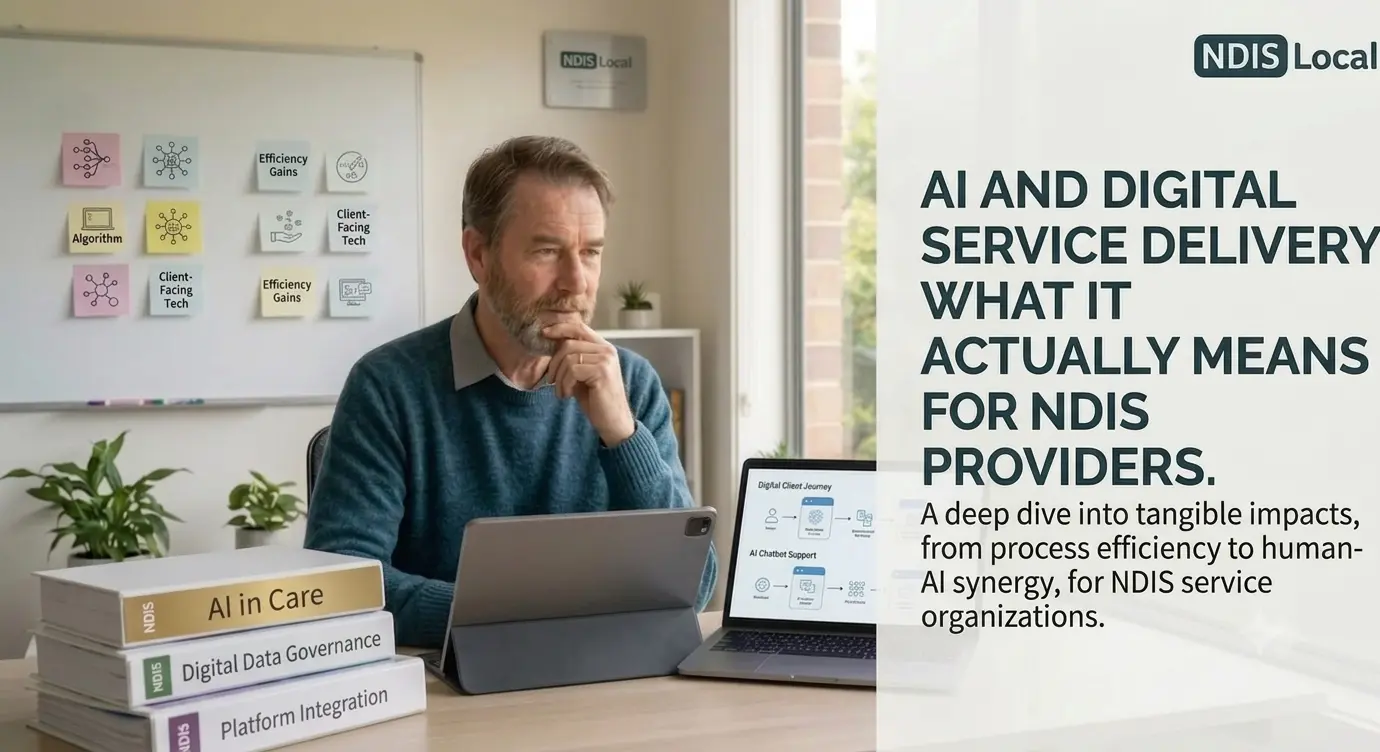
I spent the first chunk of my career on the ground — showering clients, driving them to appointments, sitting with families while they worked through what support actually looked like day to day. Now I’m on the provider side, and one of the biggest shifts I’ve noticed isn’t in the work itself. It’s in the systems sitting underneath it.
AI and automation are becoming part of the everyday conversation in this sector, whether that’s care planning software, scheduling tools, or compliance reporting that used to eat up half a coordinator’s week. I want to talk about what this actually looks like in practice, not the buzzword version.
AI-Assisted Care Planning
Care plans used to be built almost entirely from experience and instinct — a coordinator sitting down with a participant, working through goals, and drafting something based on what they’d seen work before. That’s still the core of it, and it should stay that way. But increasingly, providers are using software that suggests plan structures based on similar participant profiles, flags goals that might be missing, or prompts questions a less experienced coordinator might not think to ask.
Used well, this doesn’t replace the relationship-building that good care planning depends on. It just means less time spent on the blank page, and more consistency across a team where not everyone has eight years in the game yet.
Predictive Analytics for Participant Risk
This is the one that gets people talking, and understandably so. Some providers are now using tools that flag participants who might be at higher risk of a support breakdown — missed shifts, changes in behaviour, gaps in service usage — before it turns into a crisis.
From the support worker side, I know how much value there is in catching something early. A participant who’s suddenly cancelling shifts, or whose notes show a pattern shifting over a few weeks, is often telling you something before anyone says it out loud. The promise of predictive tools is doing that at scale, across a whole caseload, rather than relying on one worker noticing.
The catch is that these systems are only as good as the notes and data going into them. If frontline documentation is rushed or inconsistent, the “predictions” are built on shaky ground. This is a reminder that better tech doesn’t lower the bar on good documentation — if anything, it raises it.
Automating Scheduling, Billing, and Compliance Reporting
This is where I think most providers are actually seeing value right now, more than the flashier AI conversations. Rostering software that accounts for participant preferences, worker qualifications, and travel time automatically. Billing that reconciles against the NDIS price guide without someone manually checking every line. Compliance reports that used to take a coordinator a full day to pull together, now generated in minutes.
None of this is glamorous, but it’s where a lot of provider hours get freed up — hours that can go back into actual participant-facing work instead of admin. For smaller providers especially, this kind of automation is often the difference between being able to compete with the free time available versus getting buried in paperwork.
Where the Caution Should Sit
None of this is a straightforward win. A few things worth sitting with:
- Automated systems still need human oversight — especially around anything touching risk flags or care decisions
- Participant data handled by AI tools needs the same privacy and consent scrutiny as anything else in this sector, arguably more
- Cost-cutting motivations behind automation need to stay separate from quality-of-care motivations, even when they overlap
Having sat on both sides — doing the hands-on work and now managing how services get delivered — my honest take is that the good version of this technology supports better judgment rather than replacing it. The providers getting it right are the ones treating these tools as something that clears space for the human parts of the work, not something that quietly shrinks them.
That’s the version worth building toward.
