
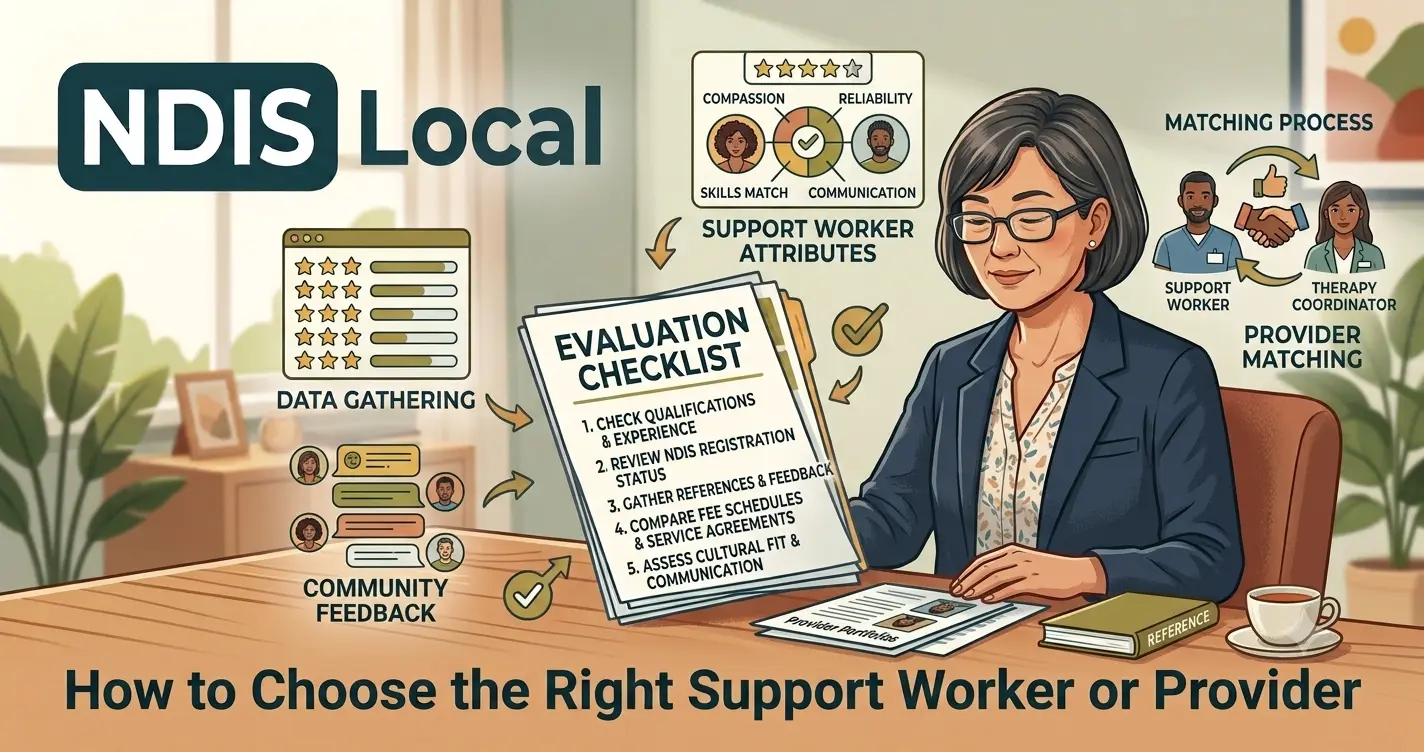
How to Choose the Right Support Worker or Provider
Another crucial aspect I note — as a support worker myself, in aged care, and now running my own provider business — if there’s one thing I wish every family understood before they started searching, it’s this: the fit matters as much as the qualifications. I’ve seen beautifully credentialed workers who were completely wrong for a client, and I’ve seen someone with less formal experience become the most important person in a participant’s week because the relationship just worked. Here’s how I’d actually go about choosing, from someone who’s been the worker, the manager, and now the business owner in this equation.
Start with what your plan actually allows
Before you look at a single provider, get clear on your funding and whether you can engage registered providers, unregistered providers, or both. This depends on how your plan is managed — plan-managed and self-managed participants generally have more flexibility to use unregistered providers, while NDIA-managed participants are restricted to registered ones. If you have a support coordinator, this is exactly the kind of question to put to them early; if you don’t, your Local Area Coordinator can usually help point you in the right direction too, even though matching you to a worker isn’t formally their role.
Where to actually look
- The NDIS provider register is the starting point for registered providers in your area — search by location and support type.
- Word of mouth from your local community is genuinely underrated. If you’re part of any local NDIS Facebook groups or community networks, ask directly — the honest reviews you get there are often more useful than a polished website.
- Your support coordinator or LAC, if you have one, will usually already know which local providers have capacity and which are worth avoiding for reasons that never make it onto a website.
The questions I’d actually ask
This is where I see families go wrong most often — they ask yes/no questions and accept whatever answer comes back. “Do you have staff experienced with autism?” is almost always going to get a “yes,” whether it’s true or not. Ask instead for specifics: “Which of your staff have worked with autistic clients, and what does that experience actually look like?” A provider who can’t answer with real detail is telling you something important.
Beyond that, here’s what I’d genuinely want to know before signing anything:
- Are they registered, and for the specific supports you need? (This matters more now than it used to, with registration requirements expanding across more support types.)
- How do they screen and train their workers, and what ongoing supervision exists once someone’s placed with a client?
- What happens when your usual support worker is sick or on leave — is there a genuine backup plan, or does the shift just get cancelled?
- What’s their cancellation policy, and do they charge for travel? If so, from what distance?
- How are complaints or concerns handled, and what does that process actually look like in practice, not just in policy?
- Can you meet the actual support worker before committing, not just speak to office staff?
Qualifications worth checking, without over-indexing on paper
For support workers specifically, a Certificate III in Individual Support is common and worth asking about, along with current First Aid/CPR and a valid NDIS Worker Screening Check — this last one is non-negotiable, not optional. But I’d weight lived experience and demeanour just as heavily as formal qualifications. Someone who’s spent years supporting people with similar needs to yours, even informally, often brings judgement that a certificate alone doesn’t guarantee.
Don’t skip the trial
If at all possible, arrange a short trial shift before locking in an ongoing arrangement — low-risk, supervised if it helps, just enough to see how the actual working relationship feels in practice. I’ve watched plenty of arrangements that looked perfect on paper fall apart in week one simply because the personalities didn’t click, and plenty of “unconventional” matches turn into years-long working relationships because they did.
Get it in writing, properly
Don’t rely on a verbal summary of terms. Ask for a written service agreement you can actually read and understand — covering rates, travel charges, cancellation notice periods, and what happens if things need to change. If anything in that agreement doesn’t make sense, ask before you sign, not after a dispute arises. A good provider won’t pressure you to sign on the spot; if they do, take that as information in itself.
Remember you can change your mind
This is the piece I most want families to walk away understanding: choosing a provider or support worker isn’t a life sentence. If the fit isn’t right after a genuine attempt, you have every right to move on and try someone else. I’d always rather a client tell me honestly that it’s not working than stay in an arrangement out of politeness or fear of being difficult — a mismatched support relationship helps nobody, least of all the participant.
In the final guide of this series, I’ll cover something increasingly relevant given the reforms landing this year: how to make the most of a community participation budget that may be getting tighter, without losing the connection and independence it’s meant to build.
