
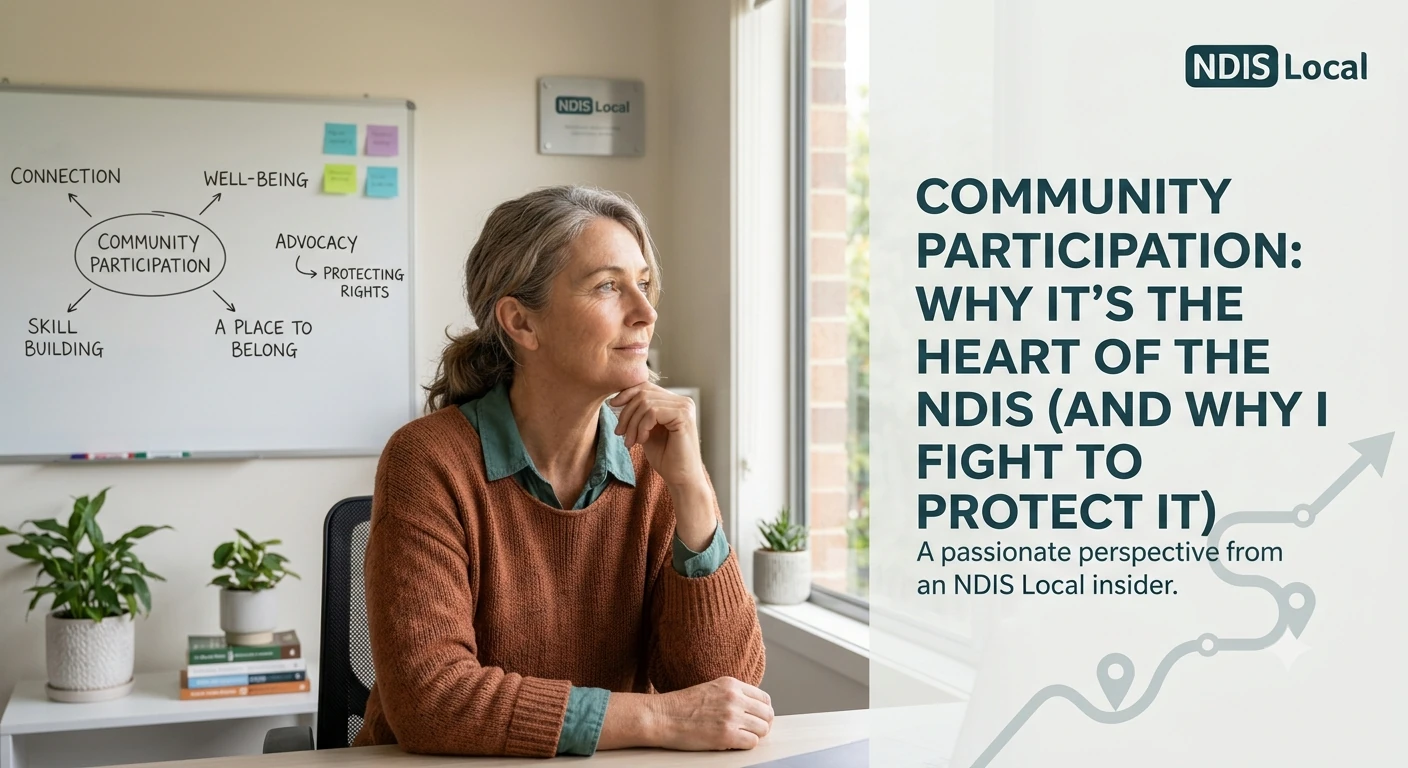
Eight years in this sector, and if you asked me to name the one support category that’s changed the most lives I’ve personally watched unfold — it wouldn’t be personal care, it wouldn’t be therapy funding, it would be community participation. I say that as someone who came up through aged care before moving into disability support, and later built my own provider business around exactly this kind of work. There’s a reason it’s one of the most requested supports on the platforms providers use to pick up shifts, and there’s a reason it’s also become one of the most talked-about categories in the sector right now — for better and worse.
What community participation actually is
If you’re new to the NDIS, this category goes by a few names depending on when your plan was written — “Assistance with Social and Community Participation,” now officially “Assistance with Social, Economic and Community Participation,” or if you’re talking about the capacity-building side of it, “Increased Social and Community Participation.” Don’t let the bureaucratic naming put you off. In plain terms, it’s the funding that pays for a support worker’s time to help someone get out into the world and actually live a life — sport, art classes, volunteering, visiting friends and family, group programs, work experience, learning to use public transport.
It’s worth being clear about what it does and doesn’t cover, because I still get this question weekly from new participants: the funding pays for the support worker’s time and transport, not the activity itself. If your client wants to join a pottery class, the NDIS funds the support worker who helps them get there and takes part alongside them — the pottery class fee itself usually comes out of pocket, unless it’s specifically built into a capacity-building program.
There are two buckets worth knowing:
- Core Supports (Assistance with Social and Community Participation) — funds support to participate right now, in whatever the person’s already doing.
- Capacity Building (Increased Social and Community Participation) — funds more structured, often time-limited programs designed to build independence and skills over time, like mentoring or public transport training, so the person needs less support down the track.
Why it matters more than the funding figures suggest
I’ve had clients whose entire week revolved around a single Tuesday session — footy training, a craft group, coffee with a friend they met through a program years ago. Take that away and you’re not just removing an activity, you’re removing a person’s routine, their social circle, sometimes their only regular contact outside their immediate family. In aged care I saw the same pattern with isolation, and it taught me something that’s stuck with me ever since: connection isn’t a “nice to have” bolted onto a support plan, it’s often the thing holding the rest of the plan together. A person who’s isolated and low on confidence needs more support across the board, not less.
That’s part of why this category has grown so fast. Spending on social and community participation nearly tripled over five years — participants and families have voted with their plans, because it works.
The part I can’t ignore right now
I’d be doing you a disservice if I wrote this post like it’s 2023. As of this year, the federal government has announced it’s resetting budgets in this exact category from October 2026, aiming to bring spending back down closer to where it sat a few years ago — with early figures floating a possible reduction of up to 50% to social, civic and community participation allocations for some plans, phased in gradually over about 12 months as plans are reassessed or renewed. Capacity building daily activity budgets are also on the table for a smaller reduction.
I want to be straight with you about the nuance here, because a lot of what’s circulating in Facebook groups overstates it: this doesn’t automatically mean every single participant loses half their community participation funding overnight. For people who aren’t currently using their full allocation, the practical impact may be smaller than the headline number suggests. And the government has been explicit that supports for things like personal care, medication, and daily living tasks aren’t part of this reset — this is specifically targeted at the “getting out into the world” category.
There’s also a genuine attempt to soften the landing: a $200 million Inclusive Communities Fund has been announced, aimed at building capability in mainstream community organisations — sports clubs, arts groups, volunteer programs — so that more genuine participation opportunities exist outside the NDIS altogether, not funded through a support worker’s hourly rate. I’m cautiously optimistic about this, but I’ve been around long enough to know that “$200 million and a strategy” and “a functioning, accessible program in your local area” can be years apart in practice.
What I’d tell a client or family right now
If community participation is a meaningful chunk of your current plan, here’s what I’m actually advising my own clients to do:
Don’t wait for your next reassessment to think about this. Start documenting why this support matters — not just “goes to art class,” but the actual outcomes: reduced anxiety, improved communication, a friendship that’s kept someone out of a much more expensive crisis support pathway. Reassessments respond better to evidence than to routine.
Get specific with your support coordinator about what’s protected. Personal care, daily living, and medically necessary supports aren’t part of this reset — make sure your plan clearly distinguishes between those and your community participation line items so nothing gets miscategorised in the process.
Look at group-based options. Group activities cost significantly less per participant than one-on-one support, and for a lot of people they deliver just as much — sometimes more — social value. If your funding is tightening, this is often the smartest place to stretch it further without losing the actual benefit.
Start building a relationship with a mainstream local organisation now, if you can. A footy club, a men’s shed, a community arts centre. If the Inclusive Communities Fund does what it says on the tin, having an existing foot in the door with a local group will put you ahead of the curve.
What this means if you’re a provider
If your business, like mine, has built a chunk of its service offering around community access and social support work, I’d be planning for a leaner but not empty market over the next 12–18 months. This isn’t a category disappearing — it’s one of the most requested support types on the platforms providers use to pick up shifts, with the median response time to a community access request sitting around two minutes and the vast majority answered within a day. Demand for the work itself isn’t going anywhere. What’s likely to shift is the shape of it — more group-based delivery, more collaboration with mainstream community organisations, and tighter scrutiny at the reassessment stage on whether the support is actually delivering outcomes.
My honest advice to other providers: don’t wait to see how this plays out. Start building genuine partnerships with local clubs, arts organisations, and volunteer programs now. If the sector is moving toward blending NDIS-funded support with mainstream community capacity, the providers who’ve already got those relationships in place are going to be the ones participants and coordinators turn to first.
Where I land on all this
I’ve never been shy about saying the NDIS needs better cost discipline — I’ve seen enough waste and enough shonky operators over eight years to know the Scheme’s sustainability matters. But community participation was never the problem child of NDIS spending in my experience; it was one of the categories actually doing what the Scheme set out to do, which is help people build real, connected lives. My hope is that the Inclusive Communities Fund turns out to be more than a headline, because if it delivers on what it promises, participants might end up with just as much genuine connection — funded a different way. If it doesn’t, we’re going to see a lot more isolation in this community over the next few years, and that’s a cost that never shows up neatly in a budget spreadsheet.
I’ll keep watching how the reassessments actually play out for real plans, not just the policy documents, and I’ll keep writing about it here as it unfolds.
